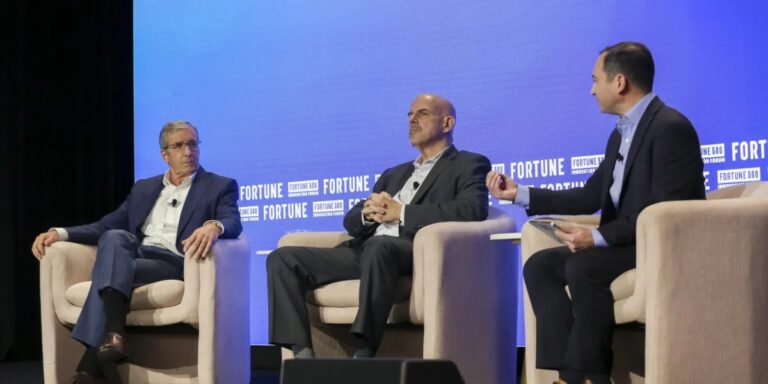
For the venture ecosystem backing frontier foundation models, the regulatory grace period is officially drawing to a close. Speaking at the Fortune 500 Innovation Forum, newly re-elected Colorado Democrat Sen. John Hickenlooper offered Silicon Valley a sobering preview of how Capitol Hill plans to govern the next generation of artificial intelligence: aggressively racing China on output, while simultaneously shackling algorithmic self-improvement and forcing hyperscalers to fund their own infrastructure.
Hickenlooper, an influential voice on the Senate Commerce Committee, drew a sharp line around recursive learning—the frontier capability where models automate their own development cycles. “Maybe we don’t need recursive learning, unlimited,” Hickenlooper remarked, expressing concern over systems “reinventing themselves sometimes outside the fence line of their domain.” For enterprise tech leadership and capital allocators, these remarks signal a fundamental shift in how Washington plans to intervene in enterprise AI roadmaps.
The Dual-Track Policy: Win the Cold War, License the Nuclear Plant
Washington’s emergent posture reflects an aggressive dual mandate. On one front, there is zero appetite to concede market dominance to Beijing. “We want to make sure that our frontier AI is the best in the world because it has the potential to dominate the globe,” Hickenlooper emphasized. Yet, rather than relying on industry-led self-policing, the senator directly compared frontier foundation models to two of history’s most strictly monitored industries: nuclear power and commercial aviation.
“We regulate nuclear weapons. We have regulations before an airplane can go into service,” he argued. “We need to look at what are some of the fundamental safeguards and guardrails that we should put in place.”
This pre-deployment certification doctrine aligns closely with warnings published by leading AI safety academics on ArXiv, including Geoffrey Hinton and Yoshua Bengio, regarding the unchecked automation of machine learning research. For seed-to-growth startups, an FAA-style compliance framework introduces serious friction. Extensive safety validation cycles, third-party code verification, and deployment certification could lengthen go-to-market timelines from months to quarters, dramatically altering venture burnout rates and early-stage capital efficiency.
The CapEx Bill Comes Due: Subsidies End at the Substation
Beyond algorithmic governance, the real margin pressure will be felt at the physical layer. Amid broader voter frustration over utility rate spikes and grid instability, the newly elected Senate is pushing forward the Bipartisan American Affordability and Jobs Act. Endorsed by President Donald Trump and advancing on a 73-25 procedural vote, the compromise bill accelerates permitting for energy generation while imposing a draconian infrastructure requirement on hyperscalers.
Under the legislation, the capital costs of constructing new substations and transmission lines will be completely borne by the data centers themselves. This represents a sea change for compute economics:
- End of Municipal Grid Externalities: Tech companies can no longer rely on shared local utilities to absorb baseline capital expenditure for massive cluster energization.
- Escalating Unit Compute Costs: Forcing data centers to directly fund grid hardware will inevitably drive up inference pricing and training cluster rental costs, squeezing margins for API-dependent AI wrappers.
- Permitting and Zoning Gridlock: New requirements mandate strict acoustic and environmental guarantees against noise and local hazards before facilities break ground.
For executive leadership teams, the message is unequivocal: the era of cheap localized power and rapid municipal approvals has hit an operational wall.
Supply Chain Paranoia and the China Equation
The geopolitical backdrop has grown exponentially more complicated following the sudden resignation of Nvidia CEO Jensen Huang over an alleged intelligence leak, prompting the Senate Banking Committee to call for immediate testimony. Hickenlooper made it clear that Senate scrutiny over proprietary hardware and model weights will tighten dramatically. “What is our relationship to China, and how secure do we feel in sharing our technology with them at any level? Because I don’t feel comfortable with that,” he noted.
For enterprise software startups and cloud service providers, the fallout is clear. The perimeter around export controls, international open-source contributions, and multinational research collaborations will contract. Startups seeking institutional funding must demonstrate rock-solid sovereign cloud architectures and supply chain segregation to withstand impending federal audits.
The takeaway for founders, operators, and venture investors is unmistakable: the next phase of enterprise AI monetization will not be dictated by algorithmic velocity alone. Navigating Capitol Hill’s infrastructure mandates and pre-market certification gauntlet will soon become the ultimate competitive moat.
Read more: Microsoft Cutting AI Costs: The Enterprise Pricing Strategy Shift